
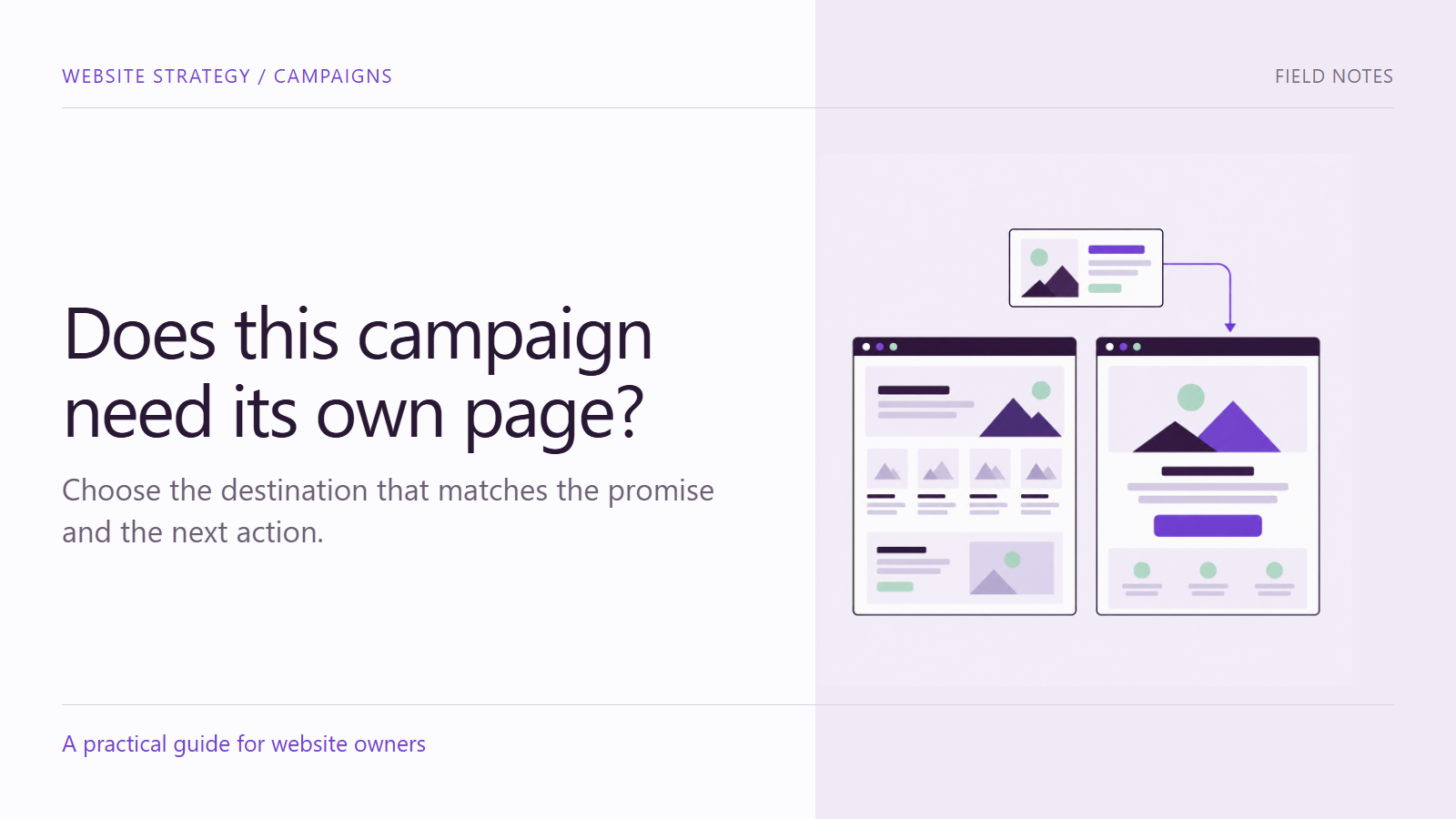
A campaign brief often includes “build a landing page” before anyone has decided what the visitor needs to understand. Sometimes a dedicated page is exactly right. Sometimes the existing service page already provides the necessary context, and the useful work is improving that page rather than adding another URL.
The landing page or service page decision should begin with the promise, audience and next action. A page is useful when it continues the visitor’s task clearly. Its label does not establish that it will perform better.
Define what you mean by landing page
In advertising, a landing page can simply mean the destination reached after an ad click. Google Ads uses the term in that sense. A service page can therefore be an ad’s landing page.
In this guide, “dedicated landing page” means a page built around a particular campaign or offer. A service page explains an ongoing service within the main website. The practical question is whether the campaign requires its own context and action, not whether one type of page is universally superior.
Write the promise before choosing the destination
Record what the visitor has seen, what they expect next and what action the business is prepared to support. Use the actual ad, email or referral message. A broad advertisement for ongoing website support creates a different expectation from an invitation to register for a specific workshop.
Then inspect the current destination. Does its opening acknowledge the offer? Can the visitor find the relevant conditions? Is the next action appropriate? A visually attractive page can still be a poor match when it answers a different question.
Use a dedicated page for a distinct ad offer
A focused page can help when the campaign promotes a specific package, audience or service scope that would be difficult to explain within the existing page. It can place the relevant explanation, evidence and action together.
For an illustrative campaign offering a defined website review, the page might explain which pages are assessed, what the review produces and how a business requests it. It should not imply a complete rebuild or guaranteed commercial result if those are not part of the offer. This example is a planning scenario, not an Armada package specification.
Give an event a complete registration route
An event page may need its own date, time zone, location or online format, intended audience and registration information. A general service page is unlikely to provide all of that context naturally.
Review what happens after registration. Check the confirmation, calendar information and any attendance instructions through a safe test. Assign ownership for updates if the schedule changes, and decide what the page should show once registration closes.
Explain a download before asking for details
A resource page should make the contents and intended use understandable. Describe what the reader will receive and what happens after the request. If a form is involved, ask only for information the workflow actually needs and make the follow-up expectations clear.
Test delivery rather than stopping at the form’s success message. Check that the correct file or access route arrives, that it works on a phone and that the resource is the current version. Avoid promising immediate delivery unless the process supports it.
Separate unusual offer conditions
A specific promotion may need enough eligibility, timing or scope information to justify a dedicated page. Keep those conditions readable and close to the action. Do not bury material limitations inside an image or leave them to be discovered after the visitor has submitted a request.
Choose an owner for the offer’s end date. A page that remains discoverable after the campaign needs an accurate next step: a clear closed message, an appropriate ongoing offer or another planned treatment. Do not improvise deletion or redirection without reviewing the page’s role and existing links.
Reuse a service page when it already fits
An existing page can be the right destination when it explains the same service, addresses the relevant audience and provides a suitable action. Improving its opening or clarifying a missing detail may be more valuable than maintaining a nearly identical campaign page.
Check that campaign-specific changes do not make the page confusing for other visitors. A service page may also serve organic search, referrals and existing customers. If one temporary offer would distort that broader role, a separate destination becomes easier to justify.
Make the decision with a short brief
- What promise brought the visitor here?
- What must the page explain for that promise to make sense?
- What evidence can the business legitimately provide?
- What is the appropriate action and confirmation?
- Does an existing page already support that route?
- Who will maintain the content and close the campaign?
Use these answers to select the smallest useful scope. A dedicated page is justified by a distinct job, not by an arbitrary requirement to create a new page for every campaign.
Measure the complete route
Agree on what constitutes a useful inquiry, registration or resource request before launch. If measurement is implemented, check it through the approved workflow and relevant privacy choices. A button click is not automatically a completed business outcome.
Review the journey after launch without attributing every change to the destination alone. Audience, offer, traffic source and operational follow-up can also affect results. Keep observations separate from explanations that still need evidence.
Choose a destination with a clear job
Armada offers website creation with planning and content structure. Share your campaign promise and current destination with Armada to discuss whether the next step is a focused landing page or a better service page.
