
The opening section of a page has a limited but important job: help someone recognize the offer and understand where to go next. It does not need to explain the entire business, and it should not rely on a clever slogan to do the work of a clear introduction.
Useful website hero copy combines a headline, a short supporting sentence and a primary action. Together, they can explain what the service is, who it helps, the useful outcome and the next step. Reviewing the three elements as a unit is often more productive than trying to make the headline answer everything.
Give each part of the opening a responsibility
The headline introduces the offer or central idea. The supporting sentence adds context that helps the reader judge relevance. The button names the action. A nearby image should explain or demonstrate something useful rather than repeat the words decoratively.
These responsibilities can overlap, but avoid making every element say the same thing. A headline about website support followed by “We provide website support” adds little. Use that sentence to explain audience, scope or the outcome the service is intended to support.
1. Name the actual service
Start with language a prospective customer can recognize. Internal package names and broad words such as solutions may be appropriate elsewhere, but the first introduction needs enough explanation to stand on its own.
Nielsen Norman Group’s guidance on taglines discusses the importance of making a site’s purpose understandable. For a service opening, a practical test is whether a reader can name what the business offers without seeing another page.
Illustrative comparison: “Solutions for tomorrow” provides little context. “WordPress support” identifies a service category. The more specific version is not automatically the final headline; it is a clearer foundation for the remaining copy.
2. Help the right person recognize relevance
Add audience context when it meaningfully distinguishes the offer. “For service businesses” may help a visitor understand the intended fit. A more detailed industry description may be appropriate when the service genuinely depends on that specialization.
Do not narrow the audience just to make the sentence sound specific. If the business serves several groups, choose wording that reflects the actual page and provide appropriate routes for different needs. Precision should come from the service strategy, not from invented positioning.
3. Explain a useful outcome without overpromising
Describe how the service helps with a recognizable task or responsibility. “Keep your site maintained while your team focuses on clients” is an illustrative supporting line that connects maintenance with the business’s daily work. It still needs to match the real scope of the offer.
Remove unsupported guarantees about revenue, rankings, security or speed. If the benefit depends on an assessment, implementation or ongoing responsibilities, explain those conditions in the relevant page content. The opening can be concise without becoming misleading.
Concrete language is often more useful than a stack of adjectives. Identify what improves or becomes manageable, then check whether the business can explain how it provides that value.
4. Name what happens next
Choose a button label that accurately describes the immediate step. “Request a quote” creates a different expectation from “Buy now.” “Explore services” offers a different commitment from starting a project inquiry.
Check the destination as part of the writing task. If the button leads to a form, the form should continue the promise made by the label. If it leads to a detailed service page, make sure that page supplies the information a reader expects.
Keep supporting links available where they help. They should not compete so strongly that the visitor cannot identify the main action. A button’s priority is a relationship between options, not simply a bright color.
Write website hero copy as a connected set
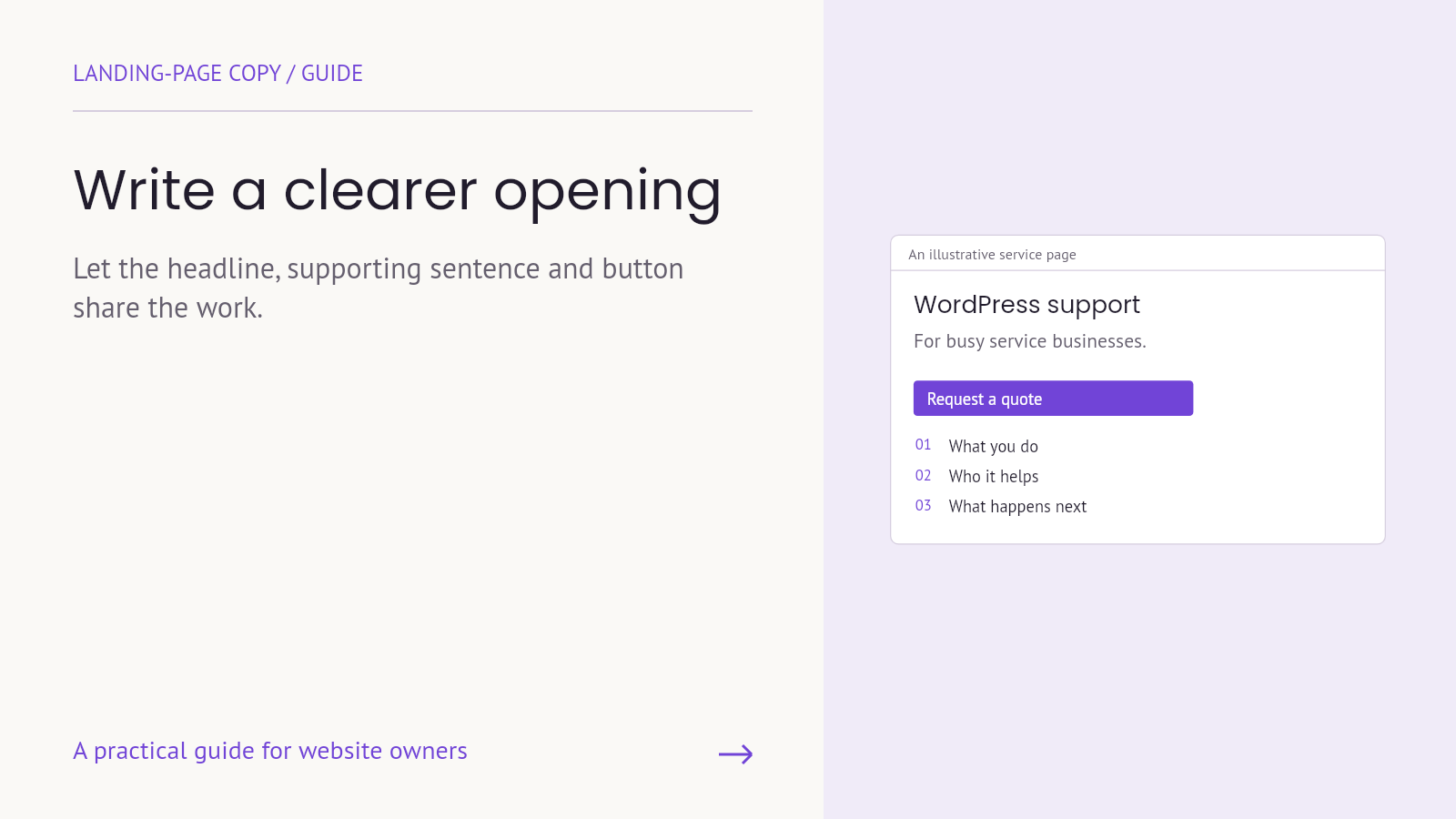
Here is an illustrative opening, not a verified offer specification:
- Headline: WordPress support for service businesses.
- Supporting sentence: Keep your site maintained while your team focuses on clients.
- Primary button: Request a quote.
The headline identifies the service and audience. The sentence explains the intended practical value. The button names the next action. Additional page sections should explain scope, responsibilities, evidence and process rather than requiring the opening to carry every detail.
Write two or three alternatives against the same brief. Compare accuracy and clarity before discussing which sounds more impressive. A distinctive phrase is useful only if the intended reader can still understand the offer.
Choose a visual that contributes information
A relevant interface example, service diagram or approved project image can help explain the page. Generic decorative imagery may occupy the most visible area without helping the reader decide whether the offer fits.
Research on photos as web content highlights the difference between informative images and visual filler. Choose the visual’s purpose before choosing its style, and label fictional examples as illustrative when they could otherwise be mistaken for real work.
Test comprehension in the actual layout
Show the opening to someone unfamiliar with the business. Ask what the company offers, who it seems to help and what they expect after using the button. Avoid explaining the intended answer before they respond.
Then inspect the mobile layout. Read the headline with its actual line breaks, check whether the supporting sentence remains visible and try the primary action. Copy that works in a document may need revision when placed beside a real image or within a narrower screen.
Record misunderstandings and revise the relevant element. This is a comprehension check, not evidence of a guaranteed conversion increase. A stronger opening still needs a useful page and a reliable process behind the action.
Make the opening a clear invitation
Contact Armada with your current page opening and the service it needs to explain to plan a clearer connection between the headline, supporting copy and next step.
